Gutter Cleaning in Jacksonville, FL
Jacksonville gets somewhere north of fifty inches of rain a year, most of it arriving in short violent bursts on summer afternoons. A gutter system either moves that water away from the house in the first ten minutes of a storm or it does not, and a trough packed with pine straw does not. We hand-clear the troughs, flush every downspout, and tell you what we saw on the fascia while we were up there.
Call Now for a Free Estimate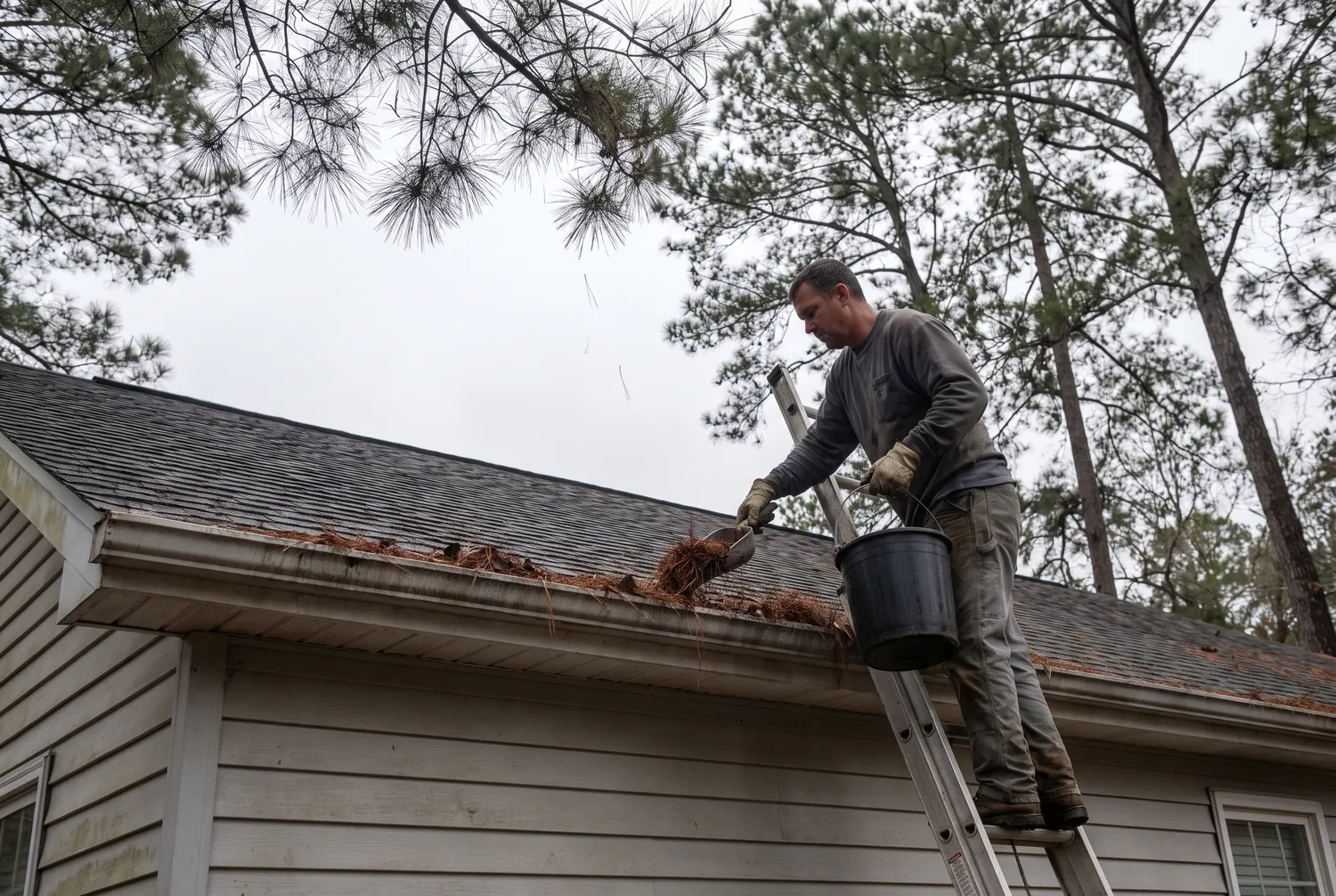
Pine Straw Is the Local Problem
Most gutter-cleaning advice is written for places with deciduous trees and a defined autumn. Everything drops over a few weeks, you clean once, you are done until spring. That is not this city.
Jacksonville runs on live oaks and pines, and neither cooperates. Live oaks shed leaves gradually across the whole year, with a heavy push in late winter as new growth pushes the old leaves off. Pines drop straw continuously, and pine straw is uniquely bad for gutters because it is long, thin and stiff. It weaves itself into a mat that water sits on top of rather than passing through, and it threads down into downspout elbows where it locks together into a plug.
Add the oak pollen and catkins in spring, plus the grit that washes off asphalt shingles in every storm, and the sediment layer at the bottom of a Jacksonville gutter builds faster than most homeowners expect.
The practical consequence is scheduling. Once a year is the standard recommendation nationally and it is not enough here. Twice is right for most homes, three times if there are pines directly over the roofline.
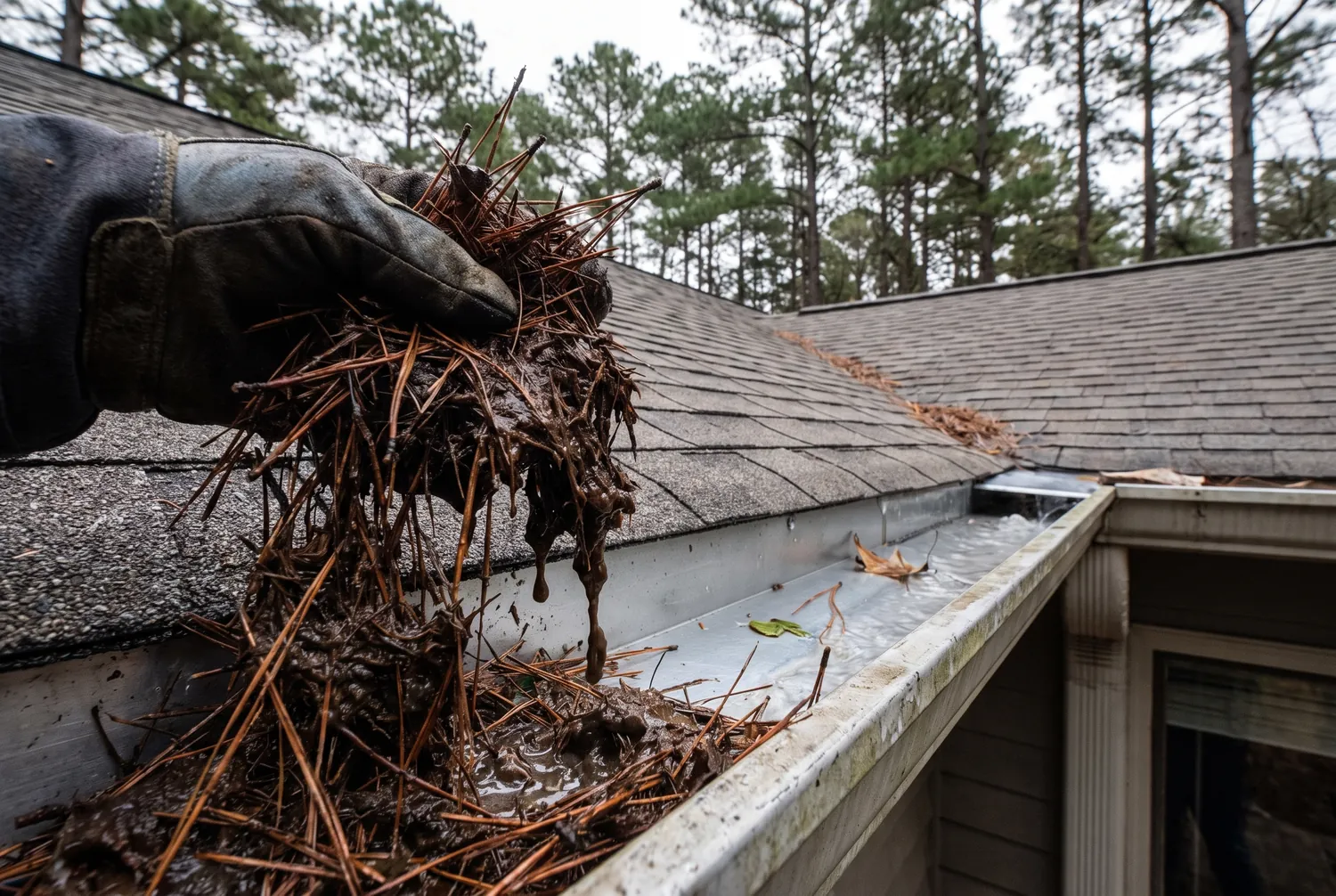
What a Blocked Gutter Actually Costs You
The failure is not dramatic, which is why it gets ignored until it is expensive.
Fascia rot. Water going over the back edge of a clogged gutter runs down the fascia board behind it. Wood stays wet, and in this humidity it does not get a chance to dry out between storms. By the time paint is bubbling, the board is usually soft and the repair is carpentry rather than cleaning.
Soffit and roof edge damage. Water backing up under the first course of shingles finds the decking. This is slow, hidden, and the most expensive version of the problem.
Foundation and landscaping. A downspout that cannot discharge dumps concentrated runoff at the corner of the house instead. On Jacksonville sand that erodes fast, and it puts water exactly where you least want it.
Mosquitoes. A level trough holding water is a breeding site, and in summer heat the cycle from egg to adult is a matter of days. If you have been wondering why the back yard is unusable at dusk, look up.
How We Do It
Hand clearing, not blowing. A leaf blower moves dry debris around and packs wet debris tighter, and it throws sludge across the roof and siding. We scoop the troughs out by hand into a bucket, so the material leaves the property instead of relocating to your flower beds.
Then every downspout gets flushed and confirmed. This is the step most often skipped, and it is where the real blockage usually lives. A trough can look perfectly clear while the elbow at the top of the downspout is solid with pine straw. We run water through and verify it exits at the bottom.
While we are on the ladder we look at the things you cannot see from the ground: loose spikes or hangers, sections that have pulled away from the fascia, seams starting to separate, standing water indicating a pitch problem, and any soft spots in the fascia board. You get told about those whether or not we can fix them, because knowing about a rotting board in August is better than discovering it in a January storm.
We bag the debris and take it with us, and we rinse down any siding that got splashed.
Gutter Guards, Honestly
Homeowners ask about guards on nearly every visit, so here is the straight version.
Guards work well against leaves. A mesh or reverse-curve system will keep oak leaves out of the trough, and that is a real reduction in volume.
Guards do not solve pine straw. Needles are thin enough to thread through most mesh apertures, and on reverse-curve designs they collect along the nose of the guard and then wash in. Fine roof grit passes through nearly everything and settles into a sediment layer underneath the guard, where it is harder to reach than it would have been without one.
So guards change the maintenance interval rather than eliminating it, and they make the eventual cleaning slightly more involved because panels have to come off. Under oaks with no pines nearby, they are usually worth it. Under pines, we would rather see you spend the money on an extra service visit each year.

What It Costs in Jacksonville
Gutter cleaning is quoted per home once we have seen the roofline and the access. What moves the number: home size, roof pitch and access, how long it has been since the last cleaning, whether guards have to be removed and reinstalled, and how many downspouts run to underground drains, which take longer to verify.
Booking gutters together with a window cleaning or pool cage visit usually saves a trip charge, since the ladder work is already on the schedule.
Call (904) 944-7358 for a Free Quote
Frequently Asked Questions
How often do gutters need cleaning in Jacksonville?
Twice a year for most homes here, which is more than the national advice of once. Live oaks shed year round rather than in one autumn dump, and pine straw arrives continuously. Homes with pines directly overhead often need three visits, and homes on open lots can sometimes stretch to one.
What happens if I skip it?
Water backs over the front lip and runs down the fascia instead of into the downspout. In Jacksonville humidity that wet wood rots quickly, and by the time paint is peeling the board underneath usually needs replacing. A blocked gutter also holds standing water, which breeds mosquitoes within days in summer heat.
Do gutter guards mean I never have to clean them again?
No, and anyone promising that is overselling. Guards keep leaves out of the trough, which genuinely helps, but pine needles thread straight through most mesh designs and fine grit still accumulates underneath. Guarded gutters need less frequent service, not zero.
Will you check the downspouts too?
Yes, and that is usually where the actual blockage is. A trough can look passable while the downspout elbow is packed solid with pine straw. We flush each downspout and confirm flow at the bottom before calling the job finished.
Already on the ladder? Pair this with residential window cleaning or pool cage cleaning and skip the second trip charge.